Consider an ordinary differential equation of the form
We need to solve this equation and obtain the value of the function  at some point
 . For any value
 and a small step
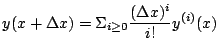
 we have
from the Taylor series expansion
where
 denotes the
 -th total derivative of at the point
. By truncating the Taylor
expansion upto some value
 we could get
fairly close to the actual solution of equation (1). However, this
requires being able to find derivatives upto order
 . That is usually
very difficult and time-consuming for arbitrary functions.
A fairly accurate method for obtaining numerical solutions to equation (1) is the Runge-Kutta method1 and is used in most packages. In this method there is no need to calculate higher order derivatives.
Runge-Kutta Methods
We describe below the Runge-Kutta method of second order:
Let the interval
 be divided into steps of size
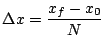 , for some appropriately chosen
 .
Assume we want to to compute
 using a formula of the
form of the form
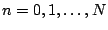
 to
 for each value of
 where
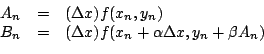
 ,
 ,
 and
 are constants to be determined, so that
(3) will agree with (2) for as high an order of terms
as possible.
On expanding
 through the Taylor expansion we get
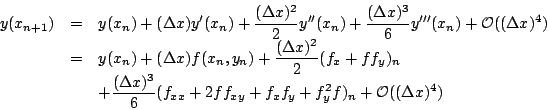 means that all functions are evaluated at
 .
On the other hand using Taylor's exapansion for functions of two variables we get that
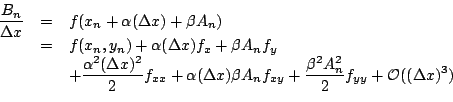 .
If we substitute this expression for  into the formula (3)
and use
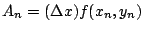 , we find after rearranging the powers of
that
 and
 to match we must have
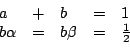
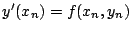 and
 .
Though there are many solutions to the above equations, the simplest are the following:

As one can see it is not necessary to compute any higher derivatives, yet it is possible to get an accuracy upto the second-order terms of the Taylor expansion. Hence this method is called Runge-Kutta of second order. An even more accurate method called the Runge-Kutta of fourth order involves computing four auxiliary quantities
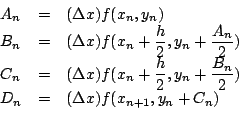
and using the formula
This method can be shown to be accurate upto the fourth order terms of the Taylor expansion. However it is too complicated and tedious to explain and justify.
What you have to do
Develop a higher order function runge_kutta_4 which solves any ordinary
initial value problem for a given parameter using the fourth order
Runge-Kutta method (4). Give at least 5 examples
of functions involving trigonometric functions, exponentials and polynomials
and setup initial value problems and solve them for chosen values of and
determine the extent to which the anlytical solutions match the numerical solutions.
Note: